“Which SEO measure actually improves rankings?” That’s the question that matters. Implementing new ideas is easy; finding out which of them work is hard. Some ranking factors barely move the needle, and a few demonstrably lead to top positions. Back in 2020 I summarised a large study of 11.8 million search results here. For 2026 I’ve updated the article completely: what does Google say itself today, what has become of the findings from back then, and where should you start?
What are Google ranking factors?
Ranking factors are the signals Google uses to decide the order in which pages appear in search results. Google evaluates hundreds of them, grouped into what it calls “ranking systems”.
Google doesn’t publish a complete list, but its guide to ranking systems describes which systems exist. A few examples:
- Helpful and reliable content systems: assess whether content is written for people and shows experience, expertise and trustworthiness.
- Link analysis and PageRank: evaluate which pages link to each other.
- Language understanding (such as BERT and neural matching): work out what a query means, even when the exact words don’t appear on the page.
- Freshness: favours newer content for searches where up-to-date information matters.
- Spam detection (SpamBrain): filters out manipulative pages and links.
Which ranking factors matter most in 2026?
What matters most is matching search intent, helpful content with demonstrable experience, links from respected sites and user behaviour. Technical factors are the prerequisite that lets the others work at all.
1. Relevance to search intent
The page has to deliver exactly what the searcher wants. Someone searching “SEO agency Hamburg” wants to find a provider, not an encyclopaedia entry. Someone searching “what is SEO” wants an explanation, not a sales pitch. For every important page, check what Google currently shows at the top for its keyword: guides, product pages, comparisons or local businesses.
2. Helpful content with experience and trust
Google describes quality with four terms, abbreviated to E-E-A-T: experience, expertise, authoritativeness and trustworthiness. In practice that means content by people who know what they’re talking about, with their own examples, evidence and a recognisable author. Since March 2024, assessing helpful content has been part of Google’s core algorithm.
3. Links and mentions
Links from other websites remain one of the strongest signals. Every link from a relevant, respected site works like a recommendation. What counts above all is links from many different domains, not lots of links from the same site.
4. User behaviour
Google uses data on how people interact with search results to assess relevance. During the US antitrust case against Google in 2023 it emerged that click data feeds into rankings through a system called NavBoost. For you, that means pages that satisfy visitors get rewarded; pages people quickly abandon to search again tend not to.
5. Technical setup and page experience
Google has to be able to fetch, understand and index your page. On top of that come Core Web Vitals – three metrics for loading (LCP), responsiveness (INP) and visual stability (CLS) – plus HTTPS and a good mobile experience. These mainly work as a foundation: without them good content has no chance, but they won’t make any page rank on their own. How to improve load times is covered in my guide to Google PageSpeed Insights.
6. Local signals
For searches with a local angle, proximity, relevance and prominence count – for example through your Google Business Profile and reviews. More under local SEO.
What did the study of 11.8 million search results show?
Backlinko (Brian Dean) analysed 11.8 million Google search results for links between page characteristics and rankings. I summarised the study here in 2020. The findings are correlations, not proof of cause and effect – but a good starting point. Here’s how I rate them in 2026:
| Study finding (as of 2020) | My take in 2026 |
|---|---|
| High domain link authority correlates strongly with better rankings. | Still true. Links remain a strong signal; quality beats quantity. |
| Position 1 had on average 3.8 times more backlinks than positions 2 to 10. | The trend holds; the figure is an average across very different queries. |
| The number of linking domains is related to rankings. | Still true. Many different recommendations work better than many links from one site. |
| No link found between page speed and rankings on page 1. | Speed is a minor factor but important for visitors and enquiries. Core Web Vitals have officially been part of the assessment since 2021. |
| Most pages have the keyword in the title tag, but with no measurable advantage. | The title still matters because Google uses it for understanding and it drives click-through. The exact keyword alone gives no edge. |
| Page-level authority (Ahrefs URL Rating) correlates only weakly. | Plausible: relevance and content often outweigh links to that exact URL. |
| Page-1 results averaged 1,447 words, evenly spread across the top 10. | Google confirms word count isn’t a ranking factor. Completeness counts, not length. |
| HTML page size shows no link with rankings. | Still true, as long as the page loads quickly. |
| Short URLs have a slight advantage. | Short, descriptive URLs are good for users. Even so, I don’t change existing URLs that rank well. |
| Structured data doesn’t correlate with better rankings. | Structured data isn’t a direct factor, but it enables rich results and helps Google understand your page. |
| Pages with longer time on site tend to rank better; 3 extra seconds equalled roughly one position. | Satisfied users count – via click data, not a measured time on site. |
Be careful with conclusions: even if a factor shows no correlation in a study, it can matter to users and so improve rankings indirectly. My own tests and client projects have confirmed some of the study’s findings and contradicted others. The devil is in the detail, and with hundreds of signals general statements are tricky. If it were that easy, we’d all be in first place.
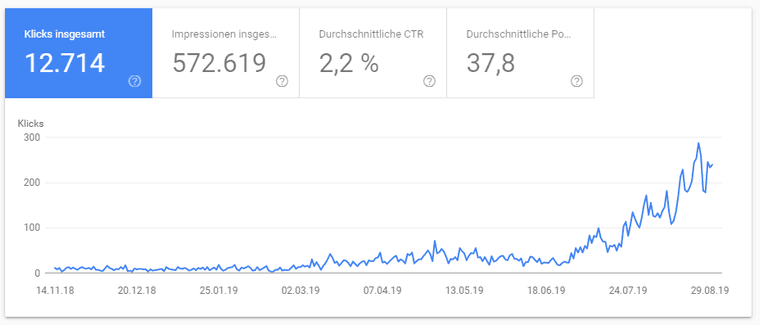
This click trend from Google Search Console, which I picked for the first version of this article, shows what happens when the key factors come together: after months without much movement, daily clicks rise sharply from June 2019.
What about AI Overviews and AI search?
For AI Overviews and AI Mode, Google uses its index and the same ranking systems. If you rank well, you stand a good chance there too. On top of that, sections that answer a sub-question clearly and on their own count, because the AI can quote them directly. How to optimise for this is covered in optimising for Google AI Overviews and GEO vs. SEO.
Where should you start to improve your Google rankings?
Check the technical side first, then improve your most important pages for intent and quality, then build trust from outside. In most projects this order delivers results fastest.
- Check the technical side: are all important pages indexed? Are there errors in Search Console? How fast does the site load on a phone? My free SEO Compass is a quick way to start.
- Check search intent: does each important page match what Google shows at the top for its keyword?
- Grab the quick wins: move pages ranking in positions 5 to 20 in Search Console forward with better content, titles and internal links.
- Deepen your content: answer questions completely, add your own experience and examples, show a recognisable author.
- Sort out internal links: link important pages from relevant articles.
- Build trust from outside: trade articles, partnerships, industry portals, reviews.
- Measure: track rankings, clicks and above all enquiries over months.
Which keywords to choose is covered in my article on SEO keyword research.
Why do Google rankings reward quality work?
The 2020 study showed what still holds in 2026: links and authority have a strong effect, while many technical details matter less than people think. Since then Google has become even better at recognising helpful content and satisfied users. For you that means focusing on the best answers for your customers, a clean technical setup and genuine recommendations. That’s how I’ve worked for my clients for years – and for my own German page, which has been on page 1 of Google for “SEO-Experte Hamburg” since 2013, often in first place.
Here’s how I help companies rank better as an SEO consultant in Hamburg. You’ll find more guides on the blog.